Mobility Minister Peter Hanke presents nationwide e-mobility campaign "Keine E-ngste mehr" (No More E-Fear!) Information offensive for the targeted reduction of fears and reservations about e-mobility
In a press conference, Mobility Minister Peter Hanke outlined the importance of information measures and raising awareness about e-mobility. In addition to a targeted funding policy and the necessary legal adjustments, the next step is to drive forward the switch to e-mobility and thereby actively shape the mobility revolution through a nationwide campaign.
Mobility Minister Peter Hanke noted at the outset: "Since the launch of the 'eMOVE Austria' programme a year ago, we have been able to massively expand the charging infrastructure and achieve record levels of new registrations alongside efficient design of funding programmes. We are therefore on track with the electrification of road traffic. However, there are still reservations and uncertainties about e-mobility – we now want to systematically dispel these with the campaign 'Keine E-ngste mehr!'."
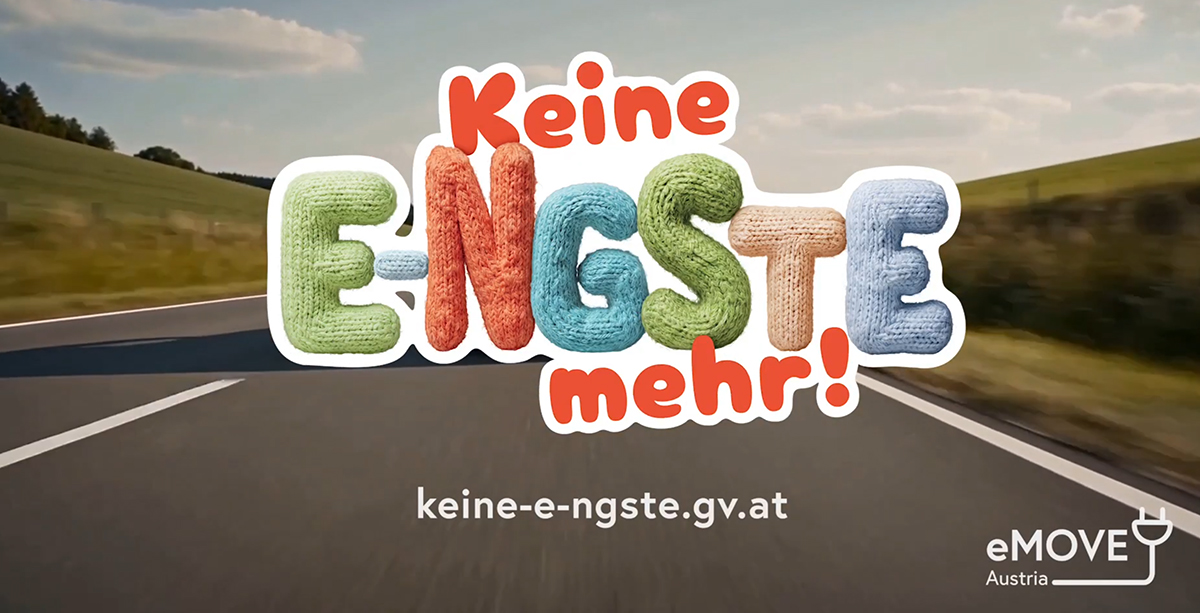
Campaign "Keine E-ngste mehr!" (no more e-fear)
A key component of the upcoming eMOVE information offensive is the creative campaign "Keine E-ngste mehr!" conceived by agency DMB. It is intended to point out existing reservations about e-mobility and simultaneously refute them with facts. For broad and thus sustainable awareness, the campaign will be rolled out nationwide from June.
To reach different target groups, the implementation will take place through various formats, from billboards to TV and YouTube to social media. In addition, the website emove-austria.gv.at has been specifically revised. As Austria's central platform for e-mobility, it now offers, in addition to all important data and information, additional facts on the subpage keine-e-ngste.gv.at addressing the "E-ngste" (fear) in the campaign's focus: charging, costs, and battery. The central advert of the campaign is now available on the Mobility Ministry's YouTube channel (BMIMI).
"I am an advocate of clear analyses and solid figures that enable corresponding deductions and initiatives for the switch to e-mobility," continued Hanke, "and therefore we will now go on the offensive not only with the provision of charging infrastructure but also with an appropriate campaign to offer information on e-mobility. In doing so, we are consistently pursuing our goal of making e-mobility more attractive to us all with eMOVE Austria by offering a successful mix of grants and necessary initiatives", so Hanke.
Targeted elimination of reservations
The campaign was preceded by a survey on the current knowledge level and attitude of the population towards e-mobility. For this, 1,000 people across Austria were questioned about e-mobility in May 2026 as part of a representative survey conducted by market mind GmbH on behalf of the Ministry of Mobility. The study will systematically evaluate the campaign "Keine E-ngste mehr!" regarding its positive impact on knowledge, acceptance, and behaviour concerning e-mobility. For this purpose, the Austrian population will be surveyed before and after the campaign and a comparison will be made. Currently, only the measurement before the campaign (zero measurement) is available.
Market research: 64 percent of people with purchase intention view e-cars positively
One of the key findings from market research: 64 percent of people who plan to purchase a car in the next twelve months view e-cars positively. This means that for more than half of the people with purchase intention, the next car should be an e-car. 43 percent of respondents have an overall positive attitude towards e-cars, 30 percent are neutral, and 28 percent have a rather negative stance.
Martin Russ, CEO of AustriaTech, added: "The study shows that information and raising awareness is the lever to utilise the already existing open mindset in this group among those interested in purchase. Therefore, the new information campaign and accompanying communication through the platform emove-austria.gv.at and social media is central to conveying facts in a target group-oriented manner and making the step to e-car easier – and thus advancing further electrification of Austrian road traffic."
The most relevant decision factors are the real range, the public charging network, charging time, and ongoing costs. 65 percent of respondents believe that the average range of an e-car is less than 400 kilometres (km). In fact, the average range value of the most popular e-cars from last year is about 400 km real range – this year it has increased further with current models. In terms of expansion of the public charging network, 59 percent of respondents state that it is not sufficiently expanded.
Currently, in Austria, there are almost 40,000 public charging points, with a strong upward trend – in 2025, Austria had the third largest growth in the expansion of public fast charging infrastructure in the EU. A similar picture emerges regarding the estimated charging time of a typical e-car: According to experts, about 30 minutes at a fast charging point is enough to charge an e-car to 80 percent. Almost 90 percent of respondents estimate that it takes longer – 44 percent even say it takes more than an hour. Moreover, it is interesting to evaluate respondents' assessments of the running costs of an e-car: 52 percent state that the operating costs of e-cars are cheaper compared to combustion engines, while the rest assess these as similarly high or higher.
There is a notable discrepancy in the assessment of operating costs, charging performance, and the quality of the public charging network: People with access to e-cars rate all three factors clearly more positively compared to combustion engine drivers. A clear insight that personal experience with e-mobility can lead to a more positive evaluation and dismantling of barriers.
Tip
Informations in German: