“No more fears!”: Mobility Minister Hanke relies on branded e-taxis for information and awareness-raising 15 branded e-taxis in Vienna, Linz, and Graz draw attention to prejudices against e-mobility until early September – Campaign informs about charging, costs, and battery
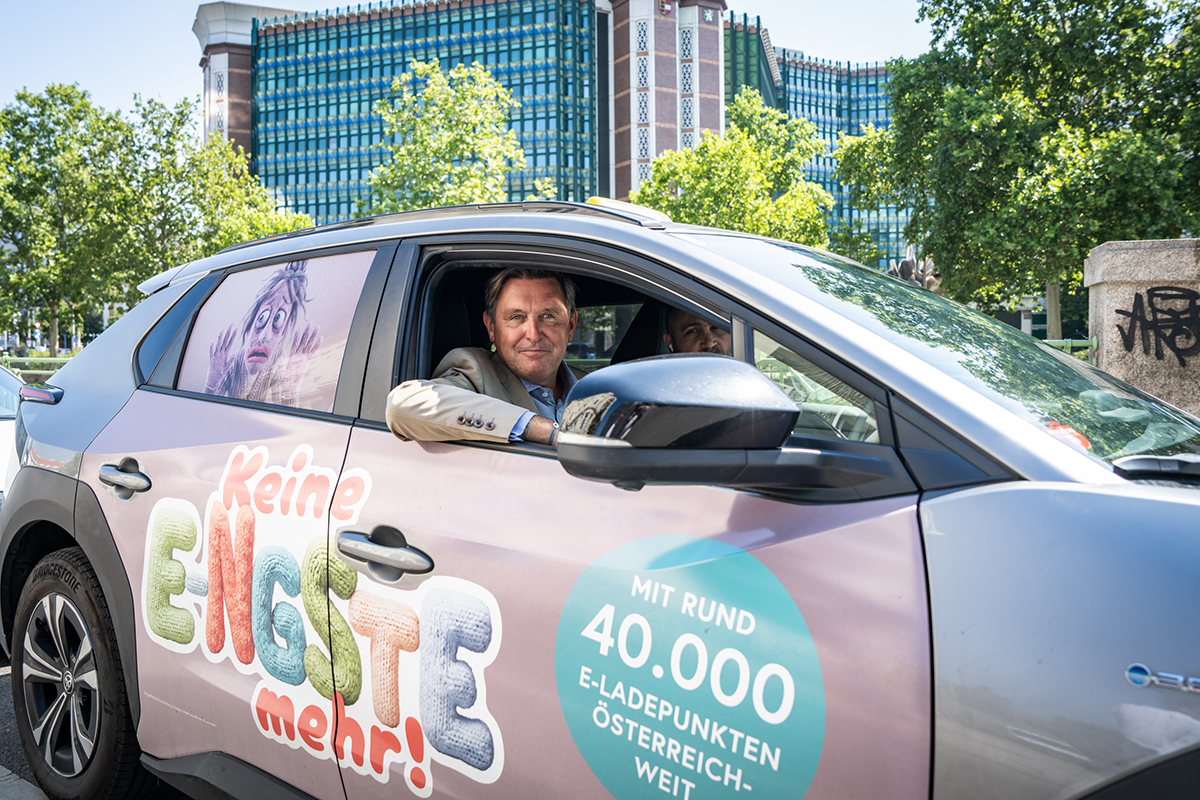
Attentive road users in Vienna, Graz and Linz have probably already noticed them: Since the summer, a total of 15 branded e-taxis are operating in the three state capitals, highlighting the key messages of the “No more fears!” campaign and addressing the most common prejudices against electric cars, countering them with facts. The campaign of the Ministry of Mobility deliberately targets areas where people interact with mobility on a daily basis. The e-taxis bring information directly to the public space, focusing on topics that are particularly relevant for deciding for or against an e-car: range and charging, costs and battery.
“Electromobility is already a reality on Austria’s roads – now we want to progress in raising people's awareness. Our e-taxis bring the messages of 'No more fears!' directly to road users. The current figures show: Interest in e-cars is high, but there are still many prejudices and uncertainties. We want to dispel these with facts and comprehensible information, enabling people to make an informed decision towards e-cars,” says Mobility Minister Peter Hanke.
E-mobility is gaining momentum – information is becoming increasingly important
The information campaign accompanies a dynamic development on Austria’s roads. Already more than 300,000 battery-electric cars are operating in Austria. At the same time, the share of purely electric cars in new registrations reached a new peak of 27.4 percent in July 2026. The charging infrastructure is also continuously growing: there are now around 40,000 public charging points in Austria. This means e-car drivers have more and more opportunities to charge their vehicles on the go.
Despite this development, a representative survey of 1,000 people conducted in May 2026 on behalf of the Ministry of Mobility shows that there is still a need for information. 43 percent of the respondents have a generally positive attitude towards e-cars, 30 percent are neutral, and 28 percent have a rather negative attitude. Especially interesting is the view of those who are actually about to buy a car: 64 percent of those with purchase intentions see e-cars positively.
“We know from market research that those people, who are planning to buy a car in the next twelve months, are especially open to e-cars. At the same time, the results show that there are still prejudices and knowledge gaps regarding range, charging, and costs. 'No more fears!' addresses exactly these aspects: We don’t want to persuade, we want to inform – with clear facts rather than myths,” says Hanke.
Range, charging, and savings in focus
The survey reveals which questions occupy people particularly when purchasing an e-car. The most important decision factors include the actual range, the public charging network, the charging time, and ongoing costs.
65 percent of respondents believe that the average range of an e-car is less than 400 kilometers. In fact, the average real-life range of the most popular e-cars from the previous year is around 400 kilometers; current models have seen further increases in range.
There are also misconceptions about charging: 59 percent of respondents feel that the public charging network is not sufficiently expanded. At the same time, there are already nearly 40,000 public charging points in Austria. According to expert opinions drawn from the campaign, approximately 30 minutes are sufficient at a fast-charging point to charge an e-car to about 80 percent. Nearly 90 percent of respondents estimate the necessary charging time to be longer. The ongoing costs also reveal a nuanced picture: 52 percent of respondents assume that operating costs of an e-car are cheaper compared to a combustion engine. At the same time, the survey shows that people with personal access to an e-car rate operating costs, charging performance, and the quality of the public charging network much more positively than those who solely drive combustion engines.
“No more fears!” visible across Austria
The “No more fears!” campaign was launched nationwide in June. It addresses existing prejudices against e-mobility and counters them with facts. The implementation ranges from posters, TV, and YouTube to social media. In addition, the central information platform emove-austria.gv.at was updated and the campaign website keine-e-ngste.gv.at was expanded. The 15 branded e-taxis in Vienna, Linz, and Graz (wrapped by the Folyo GmbH company) complement the nationwide campaign with a mobile information surface. They will be on the road in urban traffic until early September, bringing the messages of “No more fears!” directly to the people.
“With eMOVE Austria last year, we achieved important progress in charging infrastructure and new registrations. Now it's about accompanying this development with information. The more people experience electromobility themselves and the better informed they are, the easier it is to dismantle existing prejudices. That is exactly what 'No more fears!' stands for,” concludes Hanke.