Innovative renovation of historic buildings in Vienna-Favoriten: Gründerzeit building becomes a flagship project for climate-friendly living Minister Peter Hanke visits, together with Councillor Hanel-Torsch, a renovated residential building that sets new standards for sustainable refurbishment
To mark the successful completion of comprehensive refurbishment work, Minister for Innovation Peter Hanke visited the Gründerzeit building at Fernkorngasse 41 in Vienna-Favoriten. Together with the project leaders, he was informed about the innovative technologies and sustainable building practices that have transformed this historic building into a beacon of climate-friendly refurbishment.
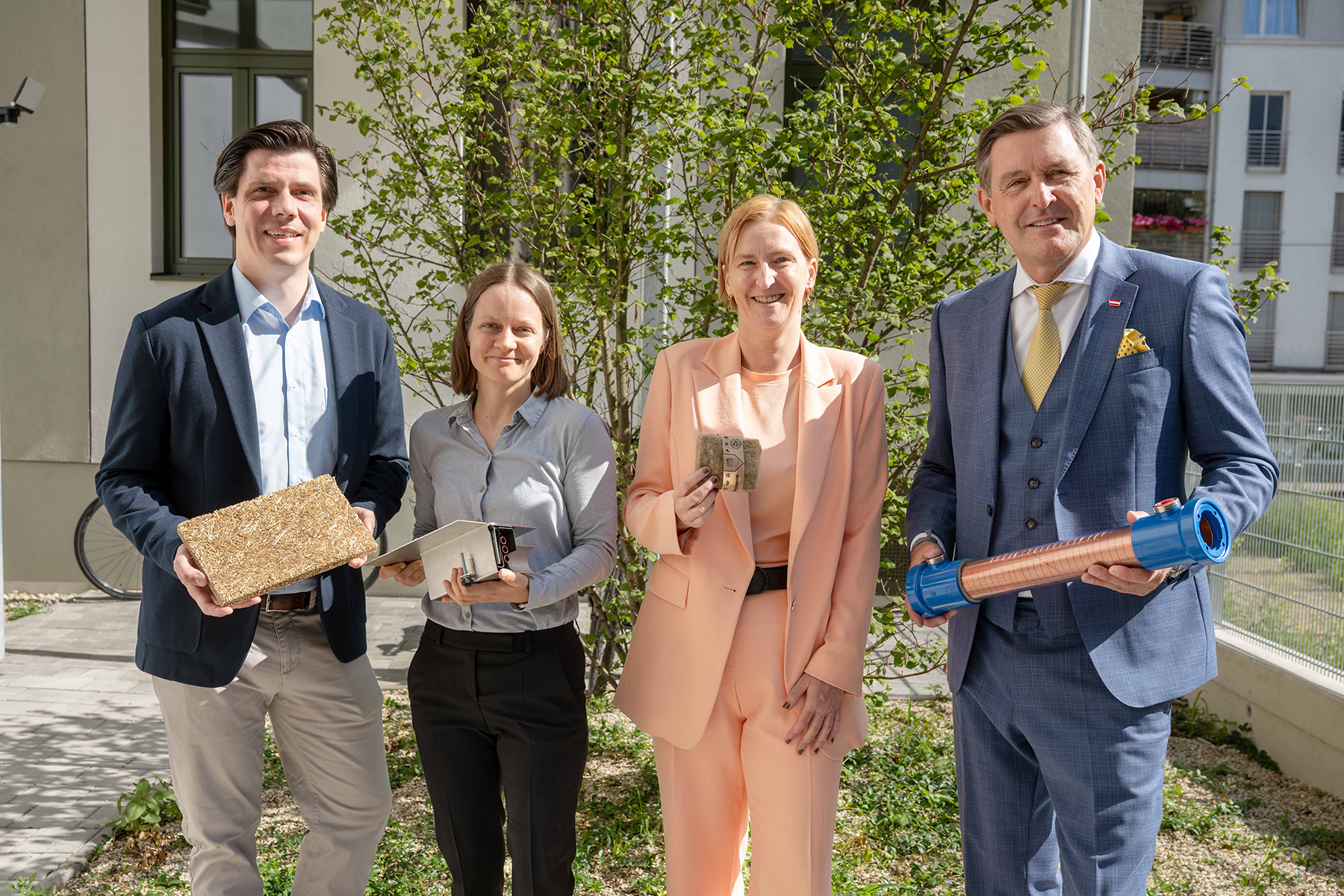
The Fernkorngasse 41 project was supported with 500,000 euros from the "Technologies and Innovations for the Climate-Neutral City (TIKS)" initiative, funded by the Federal Ministry for Innovation, Mobility and Infrastructure (BMIMI). The funding was offered in the 3rd call for proposals 2024 and aims to implement innovative technologies and practical solutions for climate adaptation in Austrian cities.
Heat from wastewater: Innovation for increased energy efficiency
At the heart of the project is a groundbreaking solution for the recovery of heat from shower wastewater, implemented nationwide in Austria for the first time. The decentralized shower wastewater heat recovery has been rolled out in all apartments of a residential building. This technology allows for a considerable portion of previously unused energy to be reclaimed from wastewater and used for hot water preparation, reducing the energy demand for hot water in a well-refurbished building by 30 to 40 percent.
“Transforming our building stock is one of the central challenges on the path to climate neutrality. This project impressively shows how technological innovation, ecological responsibility, and high residential quality can be successfully combined. Here, an important role model for the sustainable renewal of our cities has emerged,” emphasises Federal Minister for Innovation, Mobility and Infrastructure Peter Hanke.
In addition to the innovative heat recovery, the building relies on a thoroughly sustainable overall concept. The courtyard facade features, among other things, straw insulation and glass bead plaster. In a show apartment, sheep wool insulation and straw plaster carrier plates were used as ecological alternatives to conventional building materials. The entire flooring structure was also created using natural and resource-conserving materials.
Geothermal energy in urban areas unlocks new potentials
Another milestone is the building's innovative geothermal concept. Six deep probes, along with heat pumps, supply the building fossil-free with energy for heating, cooling, and hot water. Four of the probes were installed on public land – an approach rarely realized in Vienna so far, opening new perspectives for the use of geothermal energy in densely built urban areas. Combined with a photovoltaic system and heat recovery, it results in a fully renewable energy system.
78 percent less heating energy demand
The comprehensive thermal refurbishment of the street and courtyard facades, the insulation of the cellar ceilings, and the replacement of windows have reduced the building's heating energy demand by about 78 percent. Additionally, outdoor sun protection and passive cooling via underfloor heating ensure high residential comfort even during summer heatwaves.
Councillor Hanel-Torsch commends the project as a successful example of combining monument conservation and climate protection: “This project impressively proves how the historical character of a Gründerzeit building can be preserved while contributing significantly to climate-friendly and affordable living. The innovation behind this refurbishment sets an exemplary standard. The City of Vienna and the federal government jointly support with consultation and funding. The result: affordable living space with the highest residential quality, secured for generations.”
Gregor Puscher, Managing Director of wohnfonds_wien, highlights the comprehensive support through the renovation funding: “The historic corner building is brought up to date in every aspect, not only thermally and energetically. Also, the residential quality increases for residents – with more space, more freedom, accessibility, and contemporary furnishings for all apartments.”
Project manager Felicitas Wettstein from Schöberl & Pöll emphasizes the importance of the technology used: “The shower wastewater heat recovery installed in all apartments makes this project an exemplary case for resource-conserving renovation in urban areas. It shows how energy can be saved while showering and significantly reduces the hot water demand.”
Architect Günther Trimmel from Trimmel Wall Architects also highlights the innovative character: “Four of the deep probes were installed on public land – an approach rarely implemented in Vienna, opening new opportunities for geothermal use in densely built urban areas.”
Fernkorngasse 41 thus demonstrably showcases how innovative technologies, renewable energies, and ecological building materials contribute to the sustainable modernization of building stocks, setting new standards for climate-friendly city development.