As the Easter holidays begin: Ministry of Mobility offers 10 tips to reduce fuel consumption by up to 15 per cent Hanke: “These measures cost nothing and can drastically reduce your fuel consumption”
Right now, as the Easter holidays begin, many people across Austria are setting off by car on their well-deserved holidays. In light of current developments on the international energy markets and the associated high fuel prices, the Ministry of Mobility is providing information on specific measures that motorists can take to significantly reduce their fuel consumption. Even simple changes in behaviour can lead to a noticeable reduction in consumption – by around 10 to 15 per cent – which not only saves money but also benefits the environment and infrastructure.
Mobility Minister Peter Hanke emphasises: “Particularly in times of high energy prices, it is crucial that we make use of every opportunity to travel more efficiently. The recommended measures cost nothing, can be implemented immediately and can massively reduce one’s own fuel consumption. Those who drive consciously save money and, at the same time, make an important contribution to Austria’s energy independence.”
The Department for Mobility offers the following 10 tips
- Drive smoothly rather than accelerating sharply: Avoid unnecessary heavy acceleration and sudden braking. By making use of the vehicle’s momentum and ‘coasting’, you can significantly reduce energy consumption and wear and tear.
- Drive with foresight: Keeping a sufficient distance allows you to better adapt to the flow of traffic. This helps to avoid frequent braking and acceleration.
- Change gear early: Accelerate only briefly in first gear and change up quickly. From around 50 to 70 km/h, the highest gear can usually already be used. Automatic transmissions provide optimal support here.
- Drive at low revs: Modern engines are designed for low revs. Shifting to the next gear at around 2,000 revolutions per minute saves fuel and reduces noise and emissions.
- Use engine braking: When driving downhill or coasting with a gear engaged and without applying the accelerator, no fuel is consumed. This engine braking saves energy and reduces wear on the brakes.
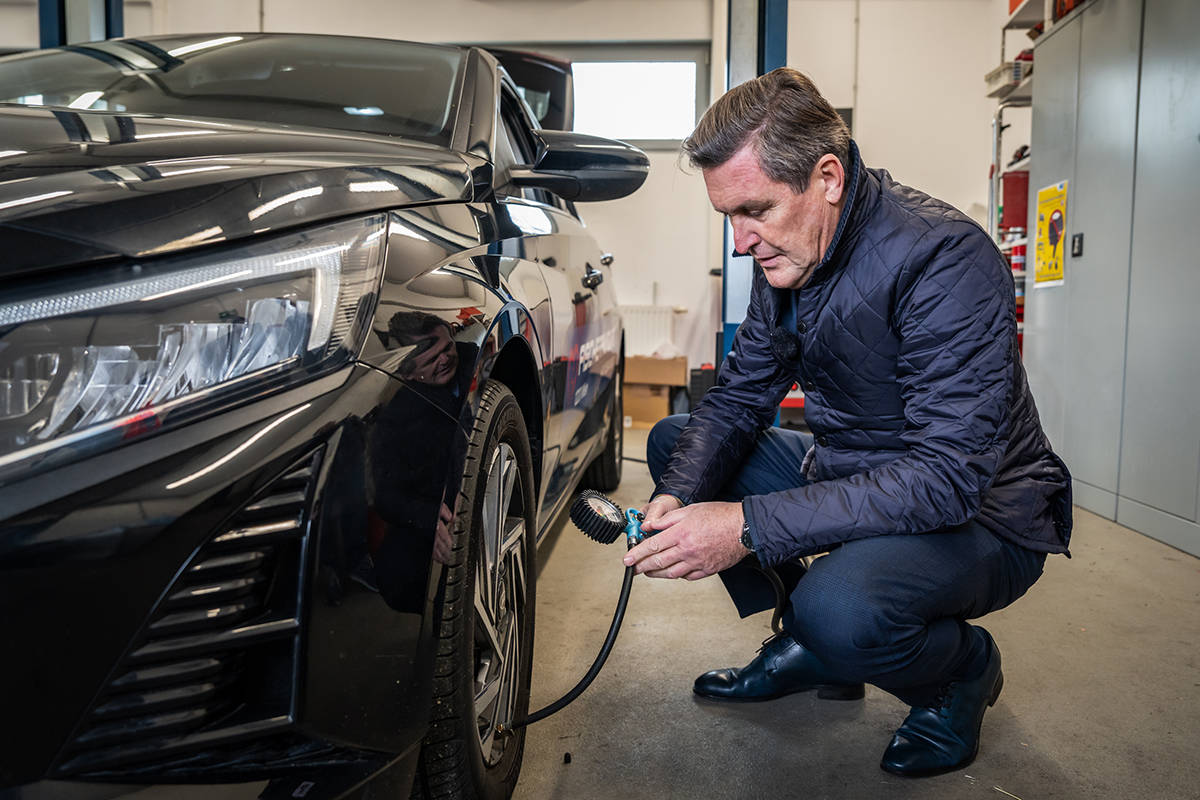
- Regularly checking tyre pressure is crucial: a pressure that is just 0.5 bar too low increases fuel consumption by around 5 per cent.
- Avoid carrying unnecessary weight and remove roof racks after use: heavy loads have a significant impact, particularly when accelerating and braking. Air resistance increases with the square of the speed. This means that at double the speed, air resistance is four times as high.
- Use electrical appliances sparingly: Air conditioning, heated seats and other electrical appliances increase energy consumption. Using them sparingly helps to reduce consumption.
- Switch off the engine when stationary: If the vehicle is stationary for longer than about 20 seconds, the engine should be switched off. Start-stop systems do this automatically.
- Drive off immediately after starting. Do not let the engine warm up whilst stationary and avoid high revs when the engine is cold.
The motoring organisations ARBÖ and ÖAMTC regularly offer fuel-efficient driving courses, providing hands-on guidance on how to reduce fuel consumption.
Finally, the Ministry of Mobility points out that the choice of transport also plays a key role: short journeys can often be covered more efficiently on foot, by bicycle or by public transport. Furthermore, sustainable mobility begins with the purchase of a vehicle – models with low fuel consumption or alternative powertrains, such as electric vehicles, offer potential for long-term savings.
“Every tank of fuel saved is a win – for people and for our energy independence,” said Minister Hanke.