Groundbreaking ceremony on Paradeis Island Green Danube gem gets a new look
With support from the EU funding programs Horizon Europe, INTERREG Slovakia-Austria, and the European Open Rivers Program, viadonau is revitalizing Paradise Island on the Danube east of Vienna.
The foundations for the measures planned in collaboration with university of natural resources and life sciences (BOKU) Vienna, the DANUBEPARKS association, and the Donau-Auen National Park were laid in the DANUBE4all project, which was launched in 2023. As a flagship project with a clear focus on research and innovation, the measures provide a blueprint for renaturation projects along the entire Danube.
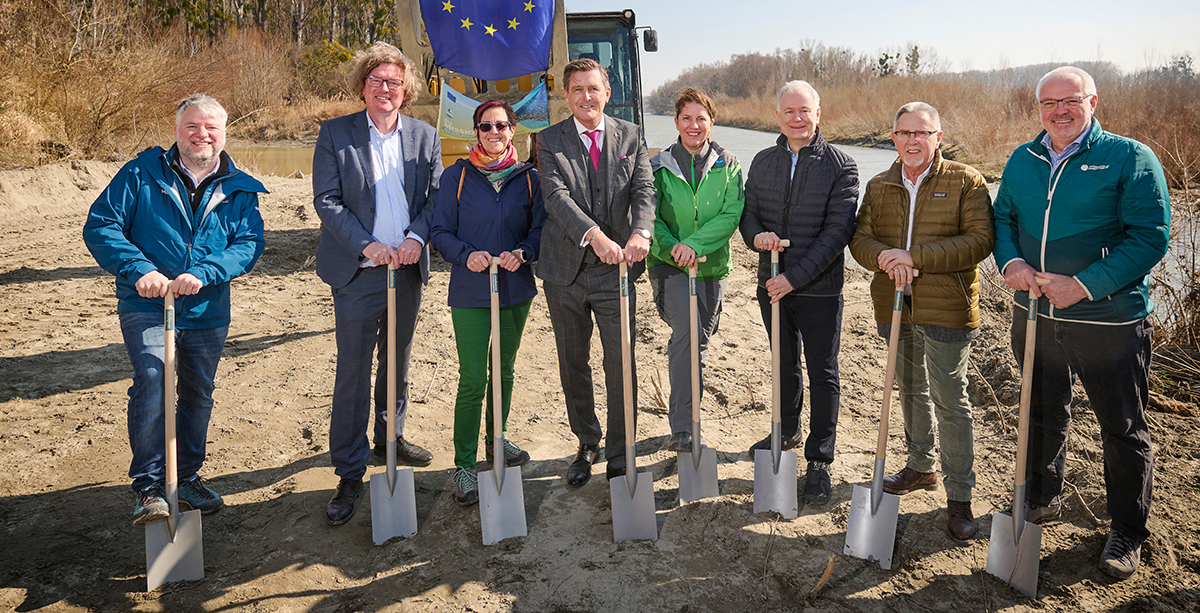
On March 6, viadonau invited guests to a ceremony to mark the start of construction with Infrastructure Minister Peter Hanke, National Park Director Edith Klauser, DANUBE4all project coordinator Helmut Habersack from the Institute for Hydraulic Engineering, Hydraulics and River Research (IWA), viadonau managing director Hans-Peter Hasenbichler, ÖBf head of the Donau-Auen National Park Johannes Wimmer, and municipal representatives from Orth and Mannsdorf.
River islands – worlds unto themselves
Where an island is still allowed to be a wild island, a species-rich flora and fauna typical of rivers can flourish undisturbed. Their isolated location between the riverbank and the main stream gives river islands their own unique river landscape character and makes them valuable natural refuges, often untouched by human hands. Between the banks of the Danube and the island, there are zones protected from waves, and the island also helps to ensure sufficient water depth in the shipping channel. In order to preserve these endangered components of a living river landscape for the future, viadonau has joined forces with numerous partners on the Austrian Danube to to protect, enhance, or even recreate river islands with particular ecological development potential using innovative solutions in integrative river engineering—as was recently done in Marktau in Upper Austria (LIFE IP IRIS AUSTRIA) and on Schwalbeninsel (LIFE WILDisland) east of Vienna.
This renaturation focus is now being consistently continued on Paradeis Island near Orth an der Donau – also in the free-flowing section east of Vienna. In the DANUBE4all project, renaturation is not understood as a “return to the 19th century,” but rather as a forward-looking approach aimed at increasing resilience and striking a balance between ecology and economy.
The river island on the left bank of the Danube between river kilometers 1903.50 and 1904.80 was once created as a result of low water regulation for shipping purposes. Due to progressive silting between the island and the bank, river dynamics that are important for flora and fauna are increasingly being lost.
From Paradeis Island to island paradise – an overview of the measures Biodiversity needs habitat diversity. Therefore, natural structures are being restored along Paradeis Island by removing hard bank structures with a total length of approximately 2.7 kilometers and lowering groyne roots. This will allow the riverbank to develop freely without worsening navigation conditions.
The upgrading of the side watercourse behind Paradeis Island – known as the Hinterrinner – creates areas protected from waves for young fish, providing optimal conditions for greater fish species diversity. The improved connectivity between the river and the floodplain, including improved conditions for future water connectivity, enables natural exchange with the groundwater body and improved absorption capacity of the surrounding floodplain in the event of flooding. In order to give the Danube's waterways more space again, the flow velocity is being reduced, which also counteracts the deepening of the river bed and at the same time helps to maintain the necessary navigable depth for shipping.
Infrastructure Minister Peter Hanke says: "Nature conservation and flood protection on the Danube – for me, these are two sides of the same coin that complement each other. The unique flora and fauna in and around the Danube need space to breathe and thrive. River islands such as Paradeisinsel are perfect for this. When we reactivate them as is happening here – by removing hard fortifications and returning to natural bank structures – nature wins, and at the same time our Danube becomes more flood-proof."
Stephan Pernkopf, Member of the Provincial Government and Deputy Governor of Lower Austria, points out the multiple benefits and potential of projects such as DANUBE4all: "Out of love for our land, we are giving our rivers more space again! This protects valuable species, but also helps in the event of flooding and thus protects the people in the region! It also creates wonderful local recreation areas for people. From the Wachau to the Austrian-Slovakian border, we in Lower Austria are already proud of a long tradition of showcase projects on the Danube, such as the reconnection of the Johler Arm near Bad Deutsch-Altenburg and the Spittelauer Arm near Stopfenreuth, as well as the renaturation of the Fischamündung. In addition to endangered fish species, birds such as the white-tailed eagle and the kingfisher, which breed there, will also benefit from the newly created dynamic floodplain landscape."
For National Park Director Edith Klauser, this island revitalisation makes another important contribution to the ecological development of the river landscape: "The renaturation of Paradeis Island is being carried out here in the Donau-Auen National Park in proven cooperation with DANUBEPARKS, viadonau and BOKU. In line with our motto 'Free river. Wild forest.', a truly wild Danube island is being recreated, along with natural structures such as gravel banks, shallow water areas and riverbank erosion. These will quickly be repopulated by animals and plants. Such projects are also internationally leading, and the Donau-Auen National Park is considered a model for successful ecological river engineering."
For Helmut Habersack (IWA), scientific monitoring of the measures is of great importance for ensuring the best possible course of development for the river: "Especially when it comes to the complex and sensitive interplay of so many ecological and river dynamic factors, as is the case here on the free-flowing stretch east of Vienna, sustainable, future-proof win-win solutions that represent both ecological and economic improvements are particularly important to us. These infrastructure measures serve to promote economic development. The overarching goals are clear: improving the ecological status and biodiversity, connecting ecosystems, reducing the risk of flooding and drought, and improving sediment continuity and navigation through nature-based solutions. With an appropriately designed package of measures, Paradeisinsel will become the benchmark for optimal renaturation measures along the entire Danube."
viadonau Managing Director Hans-Peter Hasenbichler points out the special added value of innovatively upgraded river islands for a modern waterway: "From the Marktau in Upper Austria to Schwalbeninsel and Paradeisinsel east of Vienna – in numerous projects, we repeatedly demonstrate that river islands are precious treasures of nature that also perform important functions for modern waterway development. With our idea of a holistic river, in which solutions for nature, shipping and flood protection are integrally interwoven, we are working together with many partners on the Danube to pull in the same direction. We understand that newly connected side waters, natural banks and a reviving island that is ultimately left entirely to its own devices are a living river ecological success that also brings improvements for safety and shipping."
About the funding programmes
The vision of the international Horizon Europe project DANUBE4all is to develop sustainable and interdisciplinary renaturation solutions. This is done with the involvement of the local population and stakeholders (Science-to-People) for the entire Danube region and the Danube catchment area.
The international project is being implemented by 23 partners and 24 strategic partners from the Danube region. A total of 14 different nations are involved. The lead partner is the University of Natural Resources and Life Sciences (BOKU), Institute for Hydraulic Engineering, Hydraulics and River Research (IWA).
The measures on Paradeis Island are one of three pilot measures in the project for nature-based solutions on the upper and middle Danube. While viadonau is responsible for the construction work on Paradeis Island, DANUBEPARKS Verein is responsible for planning the measures. In order to fully exploit the great renaturation potential of Paradeis Island and the surrounding riverbank section, support from other funding bodies has been secured in addition to the Horizon Europe DANUBE4all research project. For example, funds from the European Open Rivers Programme (Lost Paradise project) are being used to lower groyne roots in front of the riverbank in order to create a continuous back channel. The INTERREG Slovakia-Austria funding programme (Danuberest project) is supporting, among other things, the renaturation of the riverbank section downstream of Paradeisinsel.
The measures brought together in this way on Paradeisinsel are a successful example of targeted synergies and cooperation between various partners and funding programmes to achieve more comprehensive restoration and protection goals. The renaturation of Paradeis Island is another important component of viadonau's catalogue of measures for the Danube east of Vienna. The total budget for the construction phase of the project, including all funding, amounts to around €1 million.