Austria and Slovakia strengthen cross-border rail transport
Transport Minister Peter Hanke and his counterpart Jozef Ráž sign a memorandum of understanding for improved connections between Vienna and Bratislava and the expansion of international rail corridors.
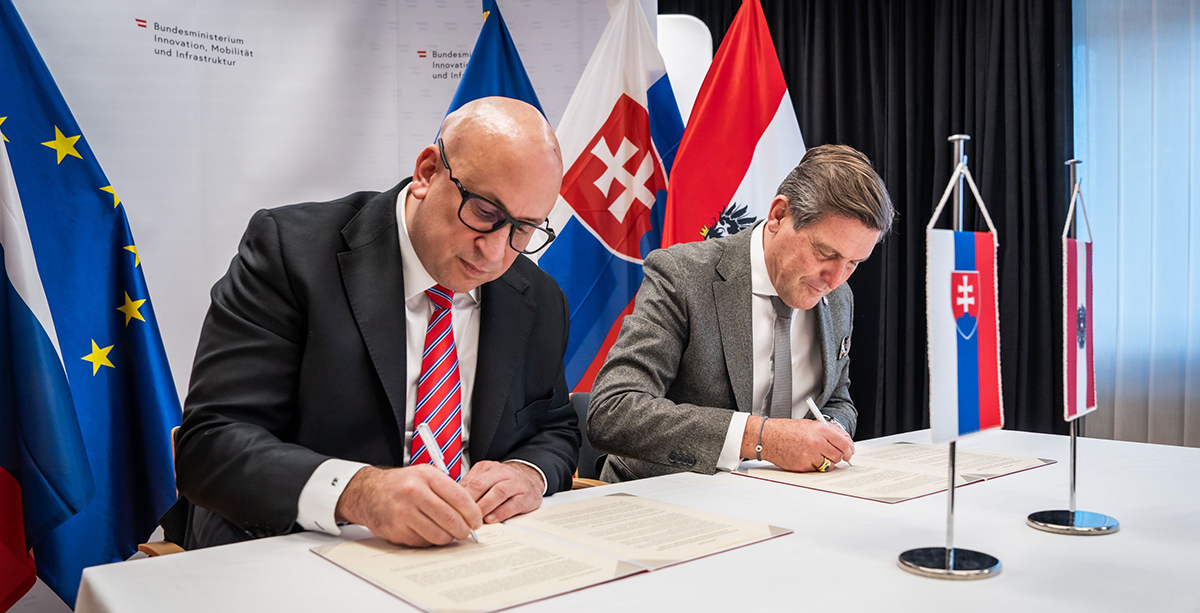
Slovak Transport Minister Josef Ráž visited his Austrian counterpart Peter Hanke in Vienna today for working talks. The meeting focused on the further development of cross-border transport infrastructure between Austria and Slovakia. As a result of the meeting, both ministers signed a joint declaration of intent to further deepen cooperation, with a clear focus on the expansion and modernisation of rail connections. The aim is to provide people in both countries with even better connections to their neighbouring country.
Transport Minister Peter Hanke: "Rail is the backbone of sustainable and efficient mobility in Europe. With today's memorandum of understanding, we are taking another important step towards faster, denser and more reliable connections between Austria and Slovakia. Our goal is modern, cross-border rail transport that brings tangible benefits to people and at the same time strengthens the business location. The close partnership with Slovakia is a key success factor in this regard."
Hourly service between Vienna and Bratislava from 2026
A key project is the further improvement of the rail connection between Vienna and Bratislava via Marchegg. The electrification and modernisation of this line, which will be completed in 2025, is considered an important milestone by both sides and forms the basis for the next stage of expansion. An important step is the further densification of the timetable with hourly connections throughout the day. This will make the service significantly more attractive and reliable for commuters, students and travellers.
On the Slovak side, plans for the double-track expansion and for equipping the section between the national border and Devínska Nová Ves with the European Train Control System (ETCS) are being pushed ahead. Both countries agreed to continue the close exchange of information on the status of planning.
New direct connections to Vienna Airport
Another component of the enhanced cooperation is the improved connection between Vienna Airport and the Slovakian rail network. Austria is pursuing the construction of a new railway line from Vienna Airport to Bruck an der Leitha (‘Airport Link’). In addition, a double-track expansion between Parndorf and the national border at Kittsee is planned. On the Slovakian side, long-term considerations are being made for a double-track expansion between Bratislava Petržalka and the national border at Kittsee.
The continuous equipping of the line with the European Train Control System (ETCS) is intended to further increase efficiency and safety in cross-border traffic. These measures would enable direct rail connections from Vienna Airport to Bratislava Petržalka and beyond in the future, thereby strengthening both the business location and international tourism.
Expansion of high-speed transport
The memorandum of understanding also sends a clear signal for the long-term integration of the region into the European high-speed network. Both countries are committed to actively supporting high-speed transport within the framework of European objectives. In Austria, there are plans to increase the maximum speed on the Vienna–Marchegg line to up to 200 km/h in the future. In Slovakia, long-term plans are being pursued for a possible high-speed connection between Bratislava and Kúty in the direction of Czechia. In the long term, these developments could open up new operational opportunities for international long-distance trains – for example, for connections between Vienna and the Czech Republic via a planned new Bratislava West station.
Coordination of modernisation of the Northern Railway towards Czechia
Another focus is the modernisation of the northern railway line between Vienna and the state border at Břeclav. In order to minimise the impact of line closures during construction work on passenger and freight transport, Austria and Slovakia want to coordinate their construction schedules at an early stage. The Slovak side has signalled its willingness to allow diversionary traffic via its rail network if necessary.